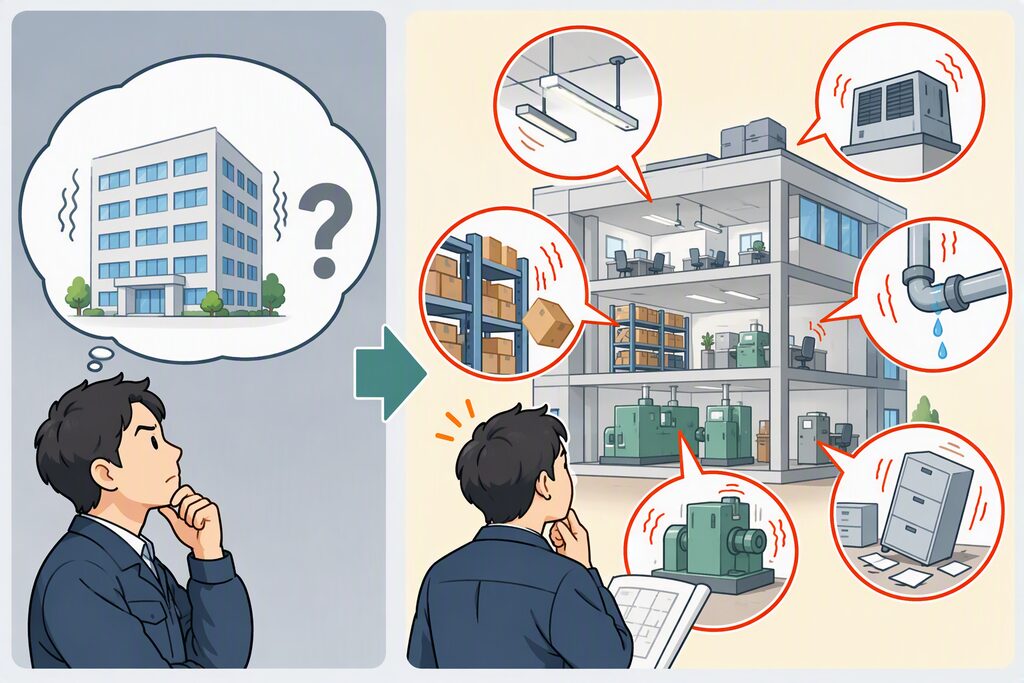

Not every building responds to an earthquake in the same way. Two buildings standing in the same city can experience noticeably different movement during the same earthquake. Even within one high-rise building, people on different floors may experience different levels of motion.
One of the most important reasons is the relationship between the earthquake’s ground motion and the building’s natural period. As discussed in our previous article, buildings — especially taller ones — have a natural period, the time it takes a structure to complete one cycle of its own vibration, and this period generally lengthens with height. This article looks more closely at what happens when that natural period interacts with an earthquake’s motion, and what it means in practice for furniture, equipment, and people.
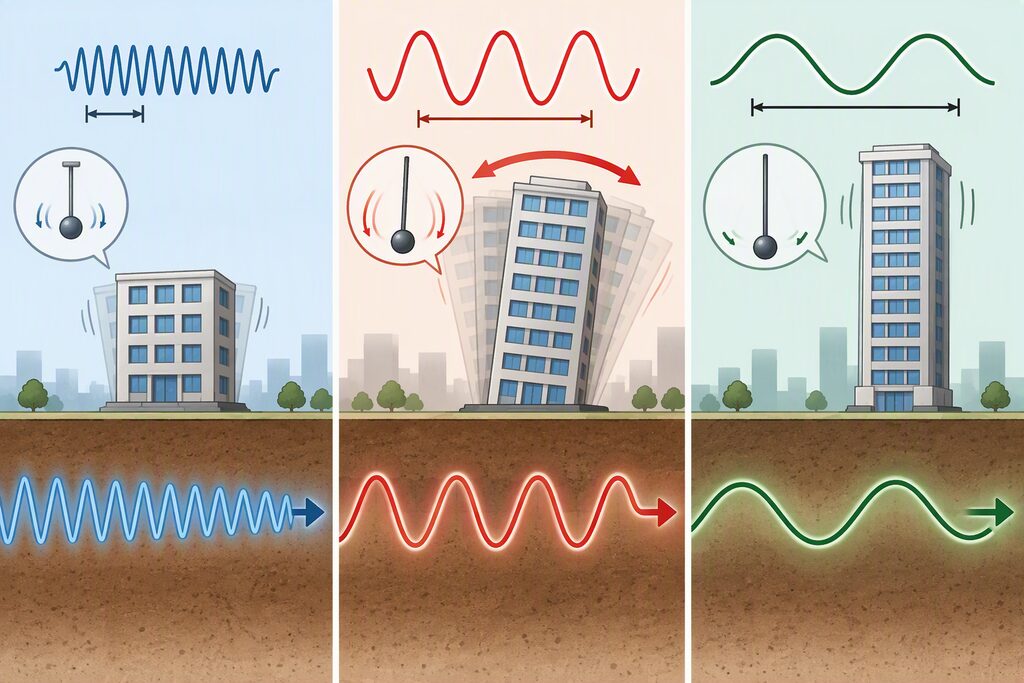
Resonance occurs when an external force repeatedly acts on a system at a frequency close to its natural frequency. A guitar or violin string offers a useful illustration. A string has its own natural frequency, and when a nearby sound matches that frequency closely, the string can begin to vibrate strongly in response — even without being touched directly. A building can behave in a broadly similar way. When earthquake ground motion contains significant energy close to a building’s natural period, the building may respond more strongly.

The Japan Meteorological Agency specifically explains that when the period of seismic motion is close to a building’s natural period, the building can resonate and experience greater movement. This is why the same earthquake can produce very different experiences in different buildings.
Long-period ground motion is particularly relevant to high-rise buildings because their natural periods tend to be longer. The Japan Meteorological Agency describes high-rise buildings as having longer natural periods than low-rise buildings and notes that they can resonate with long-period seismic motion.
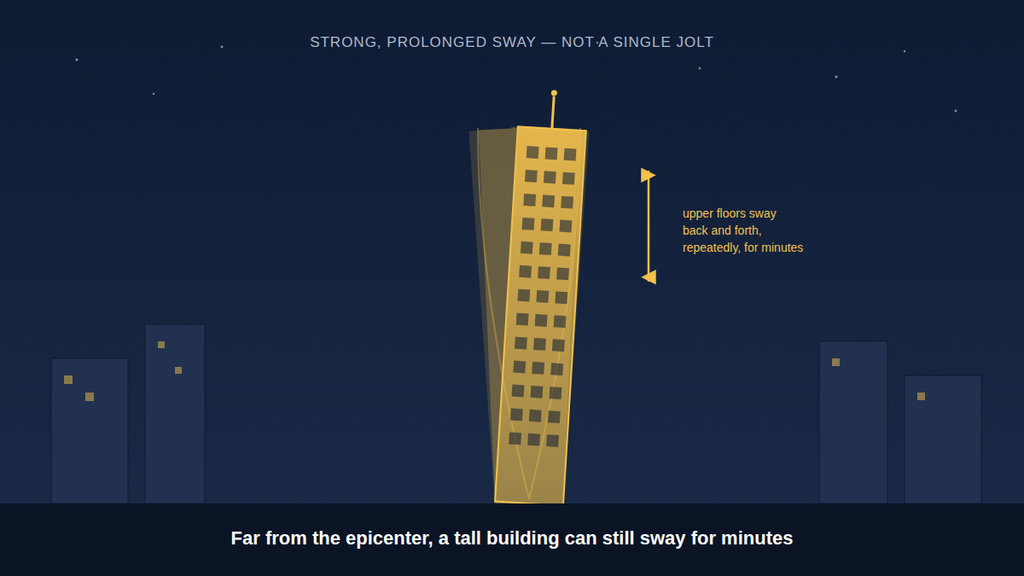
When resonance occurs, the movement may not be a single sharp jolt. Instead, the building may sway repeatedly, and the movement can continue for a considerable time. For people inside the building, this may feel very different from the short, abrupt shaking associated with many smaller earthquakes. The difference matters because prolonged movement creates opportunities for objects and equipment to shift.

The word “resonance” can sound alarming. However, resonance does not mean that a building will automatically collapse. Modern buildings are designed with seismic behavior in mind, and structural safety is a separate issue from the movement of contents.
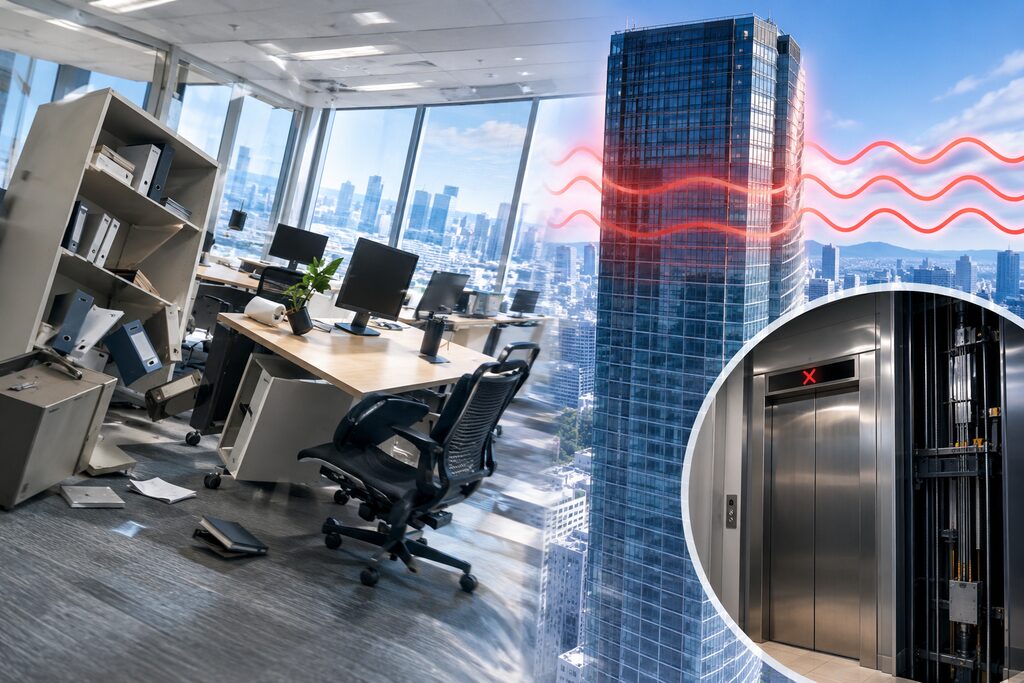
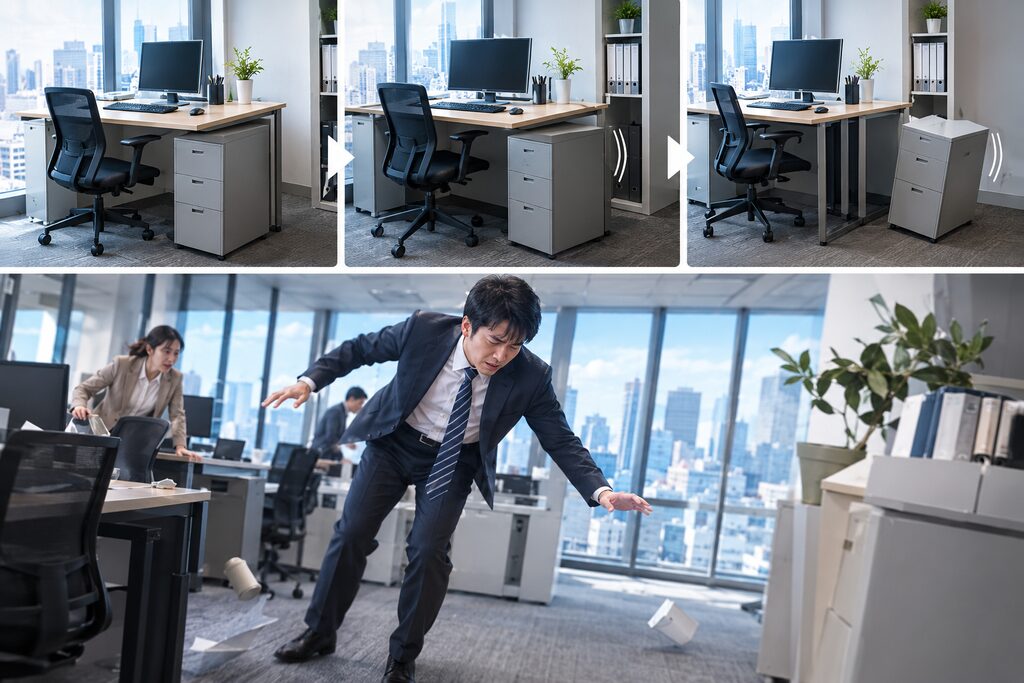
A building can remain structurally sound while its interior contents are significantly disturbed. Furniture may move. Cabinets may overturn. Equipment may slide. Ceiling or interior components may be damaged. Elevators may stop. People may find it difficult to walk or remain standing.
The Japan Meteorological Agency’s Long-Period Ground Motion Intensity scale considers human difficulty in moving and the movement or overturning of furniture and fixtures when describing the effects of strong long-period motion. Protecting the building and protecting its contents are related, but they are not the same task.
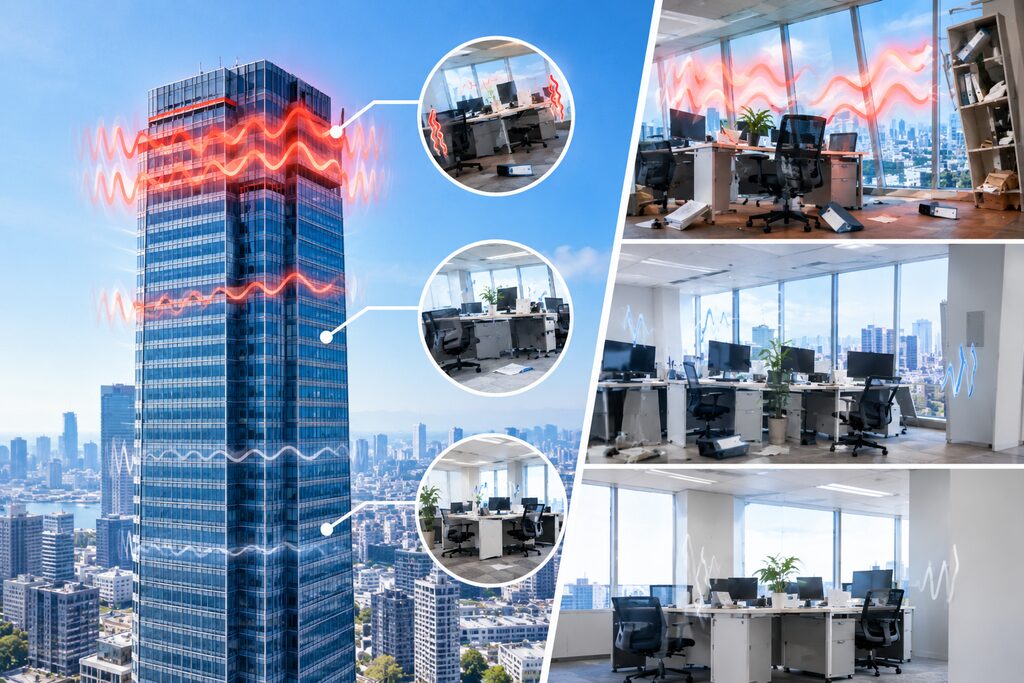
In a high-rise building, movement is not necessarily the same on every floor. The upper floors generally experience greater movement than the lower floors, as our previous article explained. This creates an important practical consideration for businesses: a cabinet that seems stable on a lower floor may experience greater movement if it is located higher in the building. The same applies to office equipment, storage furniture, laboratory equipment, and other objects.
The risk is not determined only by an object’s weight. Its height, shape, center of gravity, connection to the floor, and surrounding space can all matter.
The strength of the initial movement is not the only issue. Long-period ground motion can produce repeated movement over an extended period. This means that an object may not simply experience one sudden force — it may be pushed in one direction, move back, and then move again.
Repeated movement can gradually change the position of furniture or equipment. For people, prolonged movement can make it difficult to maintain balance. For businesses, the consequences can continue after the strongest shaking has passed: employees may need time to inspect equipment, elevators may remain unavailable until safety checks are completed, blocked corridors may need to be cleared, and equipment that has moved may need to be repositioned before operations can resume.
It is tempting to assume that a general long-period ground motion rating tells us exactly how a particular building will behave. It does not. The Japan Meteorological Agency explains that its Long-Period Ground Motion Intensity is an indicator based on ground-motion observations and estimates of the shaking that may occur in high-rise buildings. It does not fully represent the characteristics of an individual building or its local ground conditions, and movement can also differ between floors.
The same reported intensity can produce different experiences in different buildings. For facility managers, building-specific information is valuable — if a building’s natural period is known, it can help managers understand which periods of ground motion may be particularly relevant.
Earthquake information is often communicated through a single intensity or magnitude value. Those numbers are useful, but long-period ground motion demonstrates why the frequency or period content of the motion also matters.
A building does not respond in the same way to every type of ground motion. Buildings have their own natural periods, and when the period of ground motion is close to a building’s natural period, the building may resonate and experience stronger, longer-lasting shaking. The Japan Meteorological Agency (JMA) provides period-specific long-period ground motion information, which can help identify whether buildings with particular natural periods may experience stronger shaking.
JMA : Information on Long-Period Ground Motion
Once a building’s movement is understood, the next step is to consider the objects inside it. Furniture and equipment can respond differently depending on their design. A tall cabinet may be vulnerable to overturning. A wheeled device may move more easily. An unsecured appliance may slide. A monitor or other object placed near an edge may fall. A storage cabinet may release its contents.
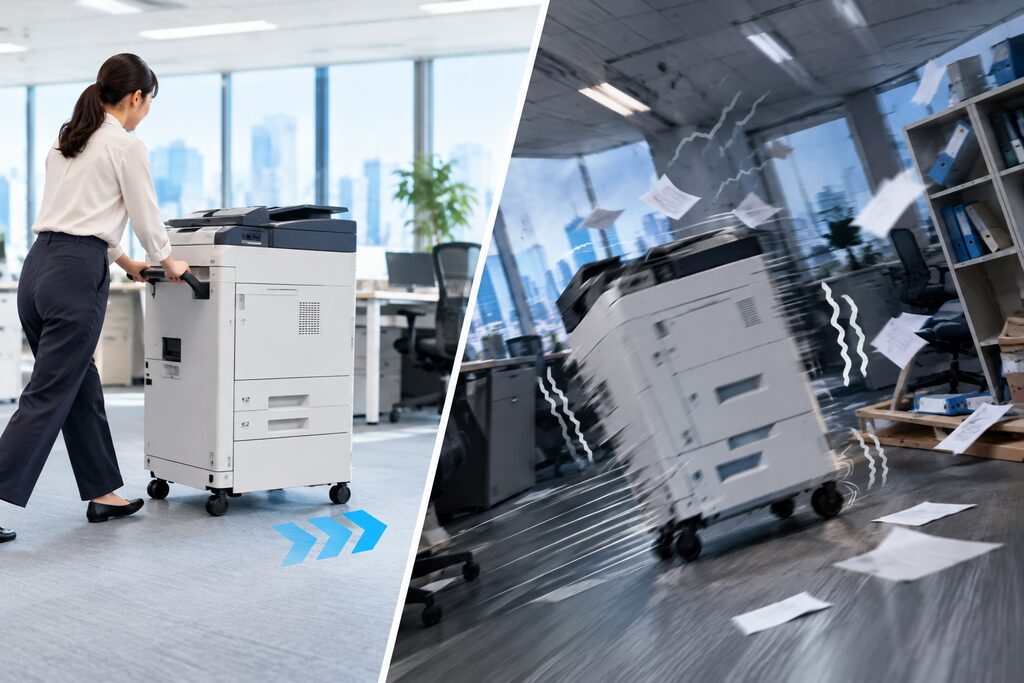
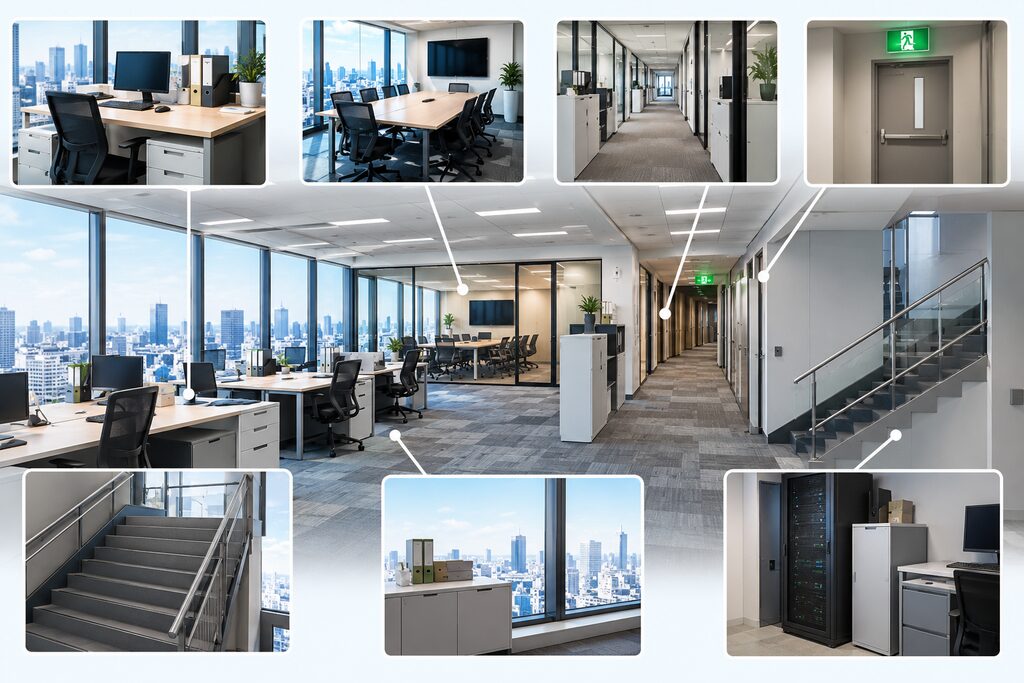
The risk is particularly important when objects are close to people, windows, stairs, corridors, or critical equipment. The objective is not to prevent every object from moving under every possible earthquake — it is to identify the objects whose movement would create the greatest safety or operational consequences.
A practical way to begin is to ask: “What would happen if this floor moved repeatedly for several minutes?”
This question encourages a different type of inspection. Instead of looking only for objects that could fall during a sudden jolt, it also considers objects that could gradually move during prolonged swaying — a cabinet that shifts several centimeters, a wheeled machine that drifts from its normal position, a corridor that becomes partially blocked.
There is no single securing method that is appropriate for every object. The weight and shape of the object, the floor and surface, the building environment, the manufacturer’s requirements, and the importance of the equipment all matter. A method that works well for office furniture may not be appropriate for heavy industrial equipment.
For furniture, shelving, refrigerators, racks, and equipment with casters, one option worth considering is a gel-based seismic adhesive pad, such as those offered by Pro7. These are designed for situations where drilling into floors, walls, or the object itself is undesirable, and can be removed and reapplied when equipment is rearranged.
As with any countermeasure, no single method suits every situation — the right choice depends on the specific object and its environment. We walk through a fuller, step-by-step approach to identifying and prioritizing these measures in our article on business continuity planning.
Resonance may sound like a technical engineering concept, but its practical implications are straightforward. Buildings have natural periods. Earthquake motion contains different periods. When those periods interact, building movement can increase. High-rise buildings generally have longer natural periods, upper floors generally move more strongly, and prolonged movement can affect people, furniture, and equipment.
Once these relationships are understood, earthquake preparedness becomes more specific. Instead of asking only whether a building is earthquake resistant, businesses can ask: Which parts of our facility are most likely to move, and what would happen if they did? That question can lead to practical improvements in furniture placement, equipment securing, emergency routes, inspections, and business continuity planning — which is exactly where we turn next.